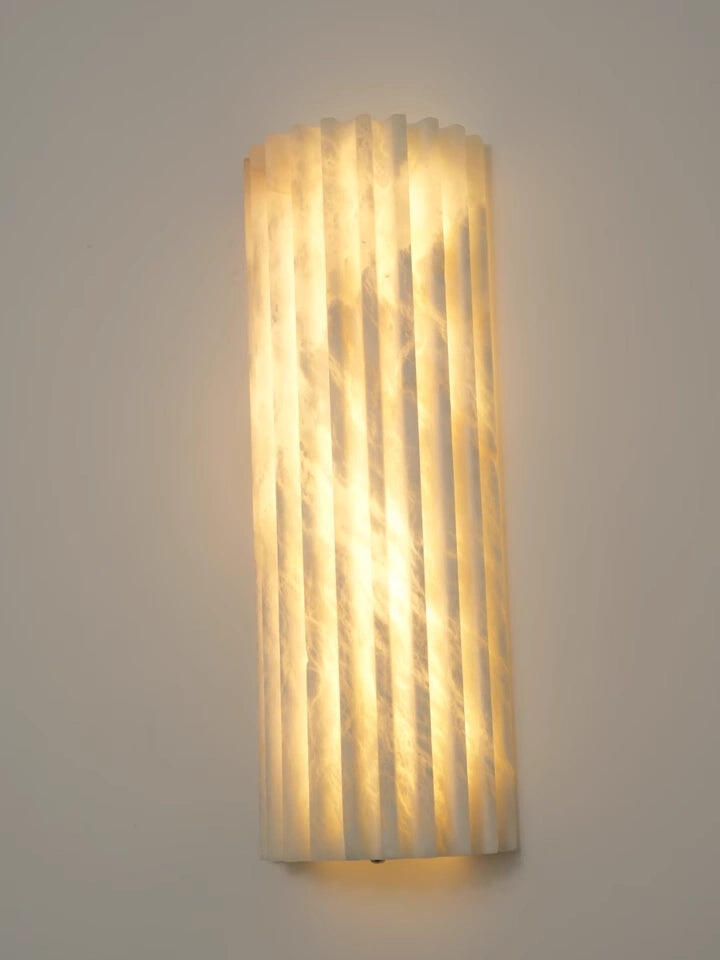
A ginkgo leaf lamp borrows the tree's fan-shaped leaf as its diffuser, and the geometry is the point: overlapping crescents of glass or metal scatter warm light in patterns no plain shade can, while the motif's Art Nouveau pedigree keeps it from dating.
Botanical lighting has one recurring failure: it turns a room into a theme. The ginkgo escapes because designers have used the leaf for over a century; it reads as ornament with a history, not a novelty.

Cloud or branch: which ginkgo form?
The Ginkgo Cloud chandelier masses its leaves into a single canopy, one object, best centered over a round table where its silhouette stays symmetrical. The Ginkgo Tip Flying chandelier scatters leaves along a branch instead: asymmetric, directional, made for rectangular tables and consoles where the fixture should travel with the surface below it.

How do you style around it?
- Give it a plain backdrop. The silhouette is the show; busy wallpaper cancels it.
- Repeat the metal, not the leaf. Echo the brass in hardware or frames, and let the ginkgo stay the only botanical.
- Dim to 40 percent for evenings. Side-lit leaves throw their crescent shadows at low brightness.
- Mix species sparingly. A lotus leaf chandelier in an adjacent room keeps the botanical thread without repetition; two leaf fixtures in one room is one too many.
For the design history behind the motif, our earlier piece on ginkgo leaf lighting traces the leaf from Art Nouveau ironwork to contemporary glass.
Ginkgo leaf lamp guide: your questions
What is a ginkgo leaf lamp?
A fixture whose diffusers or decorative elements copy the fan-shaped ginkgo leaf, usually in glass, brass or enameled metal. The leaf's split-fan geometry scatters light in overlapping crescents, which is why the motif works so well in lighting.
Where does a ginkgo chandelier work best?
Over dining tables, reading corners and entry consoles, anywhere the fixture is seen against a plain surface that lets the branching silhouette read. Allow 30 to 36 inches above a table and 7 ft over walking areas.
Does botanical lighting date quickly?
Trend botanicals do; the ginkgo does not. The leaf has been a design motif since Art Nouveau and reads classic rather than seasonal, the same way acanthus or laurel do in older ornament.
What finish pairs with ginkgo lighting?
Brass stems with white or amber glass leaves are the classic pairing and sit well against warm neutrals and wood. For cooler rooms, enameled green reads botanical without turning thematic.
What bulbs do leaf-form chandeliers take?
Small-base dimmable LEDs, 2700K, under the rated wattage. Leaf clusters shade the bulbs from most angles, so pick clear or frosted by whether you want sparkle between the leaves or a pure glow.